Overview
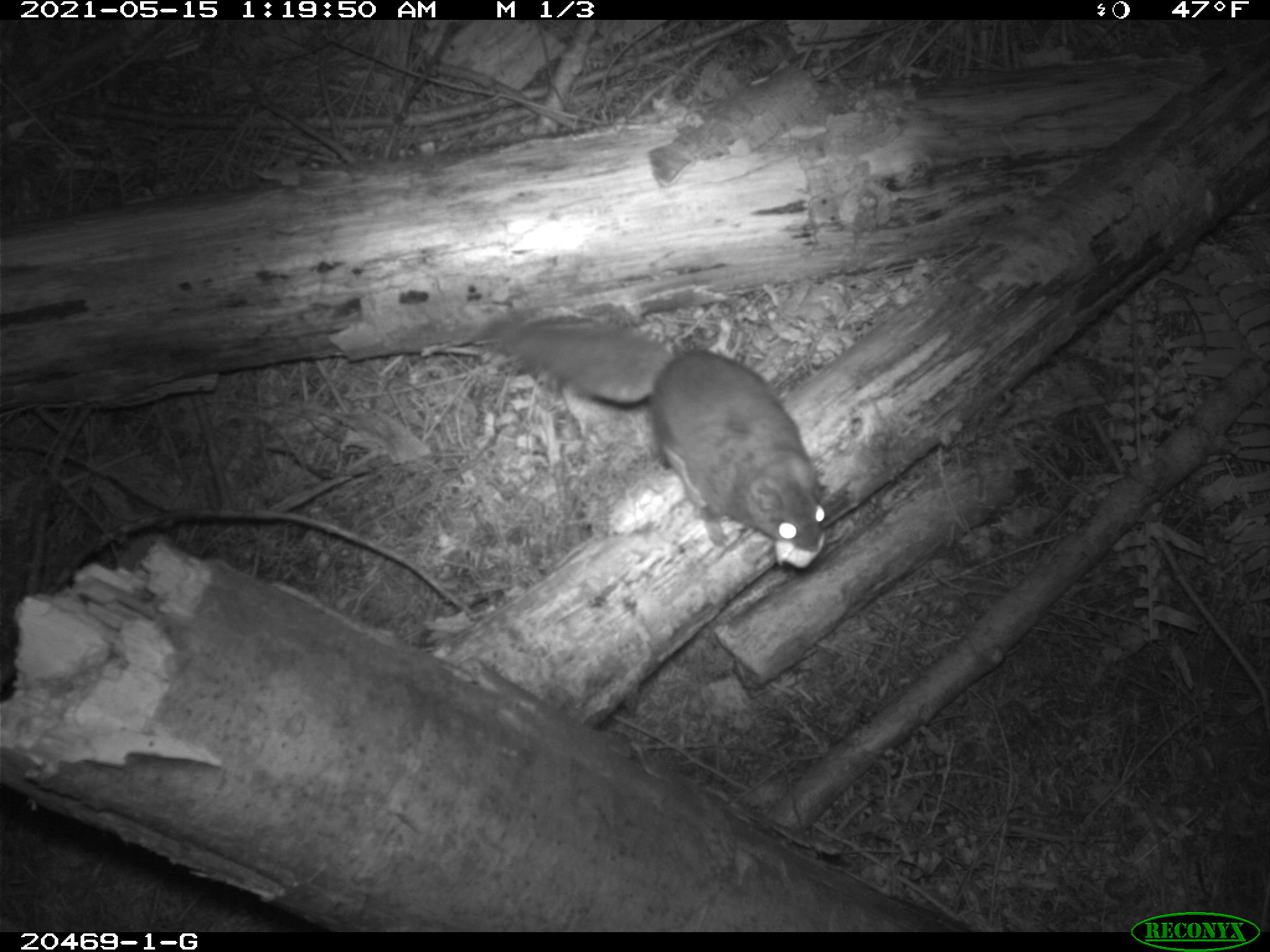
This dataset contains 99,909 images from camera traps in western Oregon, USA. These cameras were primarily deployed by the U.S. Forest Service as part of biodiversity monitoring under the Northwest Forest Plan Effectiveness Monitoring Program. Additional data from external projects in western Oregon are also included. These studies were conducted in the H. J. Andrews Experimental Forest, Elliott State Forest, Oregon Dunes National Recreation Area, and public lands managed by the Siuslaw National Forest and Bureau of Land Management.
Cameras in the Oregon Coast Range include paired deployments of trail- and ground-facing cameras to capture large and small animals, respectively. Ground cameras were set at a height of approximately 1m and facing downward. Cameras from the other studies comprise a combination of baited cameras and un-baited trail-facing cameras.
Manually drawn bounding boxes with class labels are provided for 91,045 images. The remaining 8,864 images are from camera false triggers and contain no animals.
Classes comprise a mix of species-level and higher taxonomic groups. We did not attempt to identify mice, voles, moles, or shrews to species and labeled these all as “small mammal.” The most common labels are “catharus species” (11,632), “black-tailed deer” (11,021), “townsend’s chipmunk” (8,880), and “douglas squirrel” (8,231).
These images were used to train and evaluate a YOLOv8 multiclass detector model (Appel et al., In Review). Splits are noted in the metadata for training, validation, and testing.
Citation, license, and contact information
If you use this dataset, please cite:
Appel CL, Lesmeister DB, Kay J, Hallerud M, Tosa MI, Levi T. Oregon Critters: A computer vision model for multispecies wildlife detection from two camera trap modalities. In Review.
For questions about this data set, contact Cara Appel.
This data set is released under the Community Data License Agreement (permissive variant).
Data format
Annotations (including species tags and unique location identifiers) are provided in COCO Camera Traps format.
For information about mapping this dataset’s categories to a common taxonomy, see this page.
Downloading the data
Metadata is available here.
_hd.JPG)
_hd.JPG)
_hd.JPG)