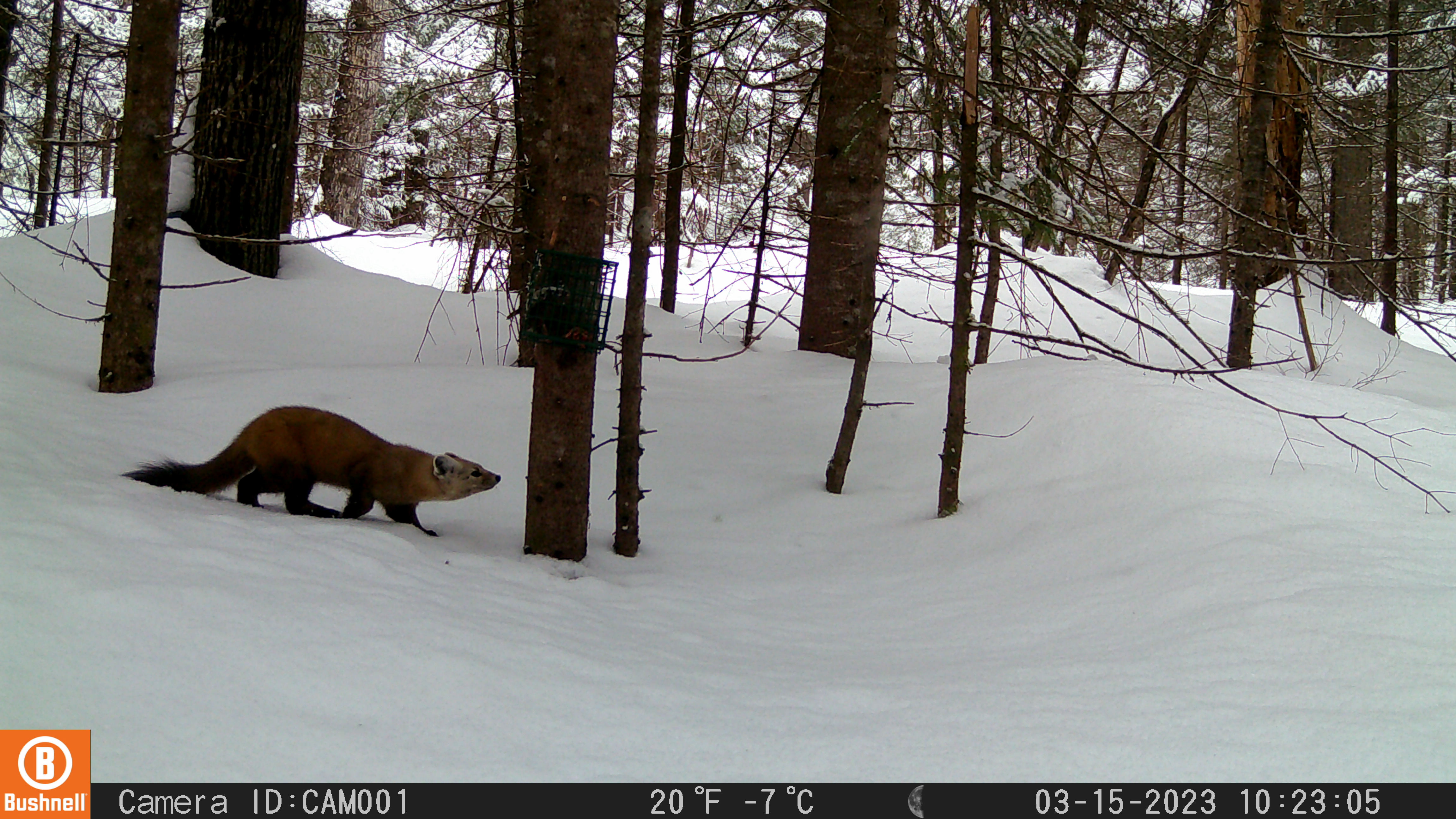
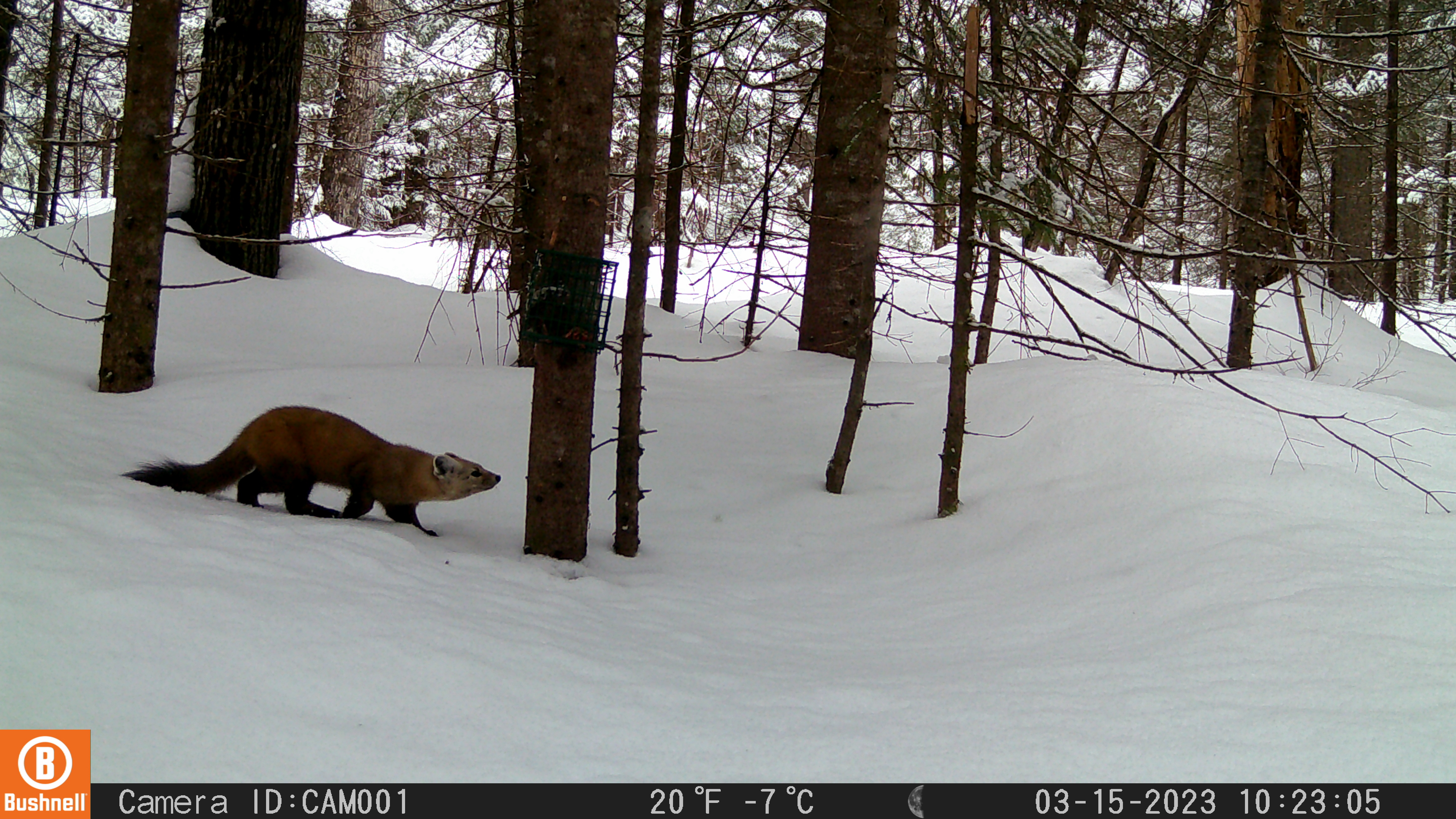
This dataset is a composite of ten camera trap datasets from the AMMonitor community, a collaboration of independent projects that use the AMMonitor R package to monitor wildlife with remotely deployed devices such as trail cameras and audio recorders. Individual datasets are available on ScienceBase.
The composite dataset includes around 1.2M images, about half of which are empty. The most common non-empty categories are moose (232,913 images), white-tailed deer (115,240 images), and fisher (47,505 images).
Summaries of the individual datasets are included below, in the “individual datasets” section. Each image in the metadata includes a “dataset” field that specifies the dataset from which it came.
Latitude/longitude information has been removed for the composite release, but is available (with some geographic blurring) in the original datasets. Images containing humans have also been removed.
The “individual datasets” section below contains citation information for each of the constituent datasets; if you use images from any of these datasets, please cite them individually.
Each of the constituent dataset pages also lists contact points for specific datasets. For questions about the composite data set, contact Laurence Clarfeld.
Constituent datasets were released into the public domain on ScienceBase. Dataset pages request that users notify individual dataset owners when datasets are used.
Annotations (including species tags and unique location identifiers) are provided in COCO Camera Traps format.
Metadata is available here.
Images are available in the following cloud storage folders:
- gs://public-datasets-lila/ammonitor-camera-traps (GCP)
- s3://us-west-2.opendata.source.coop/agentmorris/lila-wildlife/ammonitor-camera-traps (AWS)
- https://lilawildlife.blob.core.windows.net/lila-wildlife/ammonitor-camera-traps (Azure)
We recommend downloading images (the whole folder, or a subset of the folder) using gsutil (for GCP), aws s3 (for AWS), or AzCopy (for Azure). For more information about using gsutil, aws s3, or AzCopy, check out our guidelines for accessing images without using giant zipfiles.
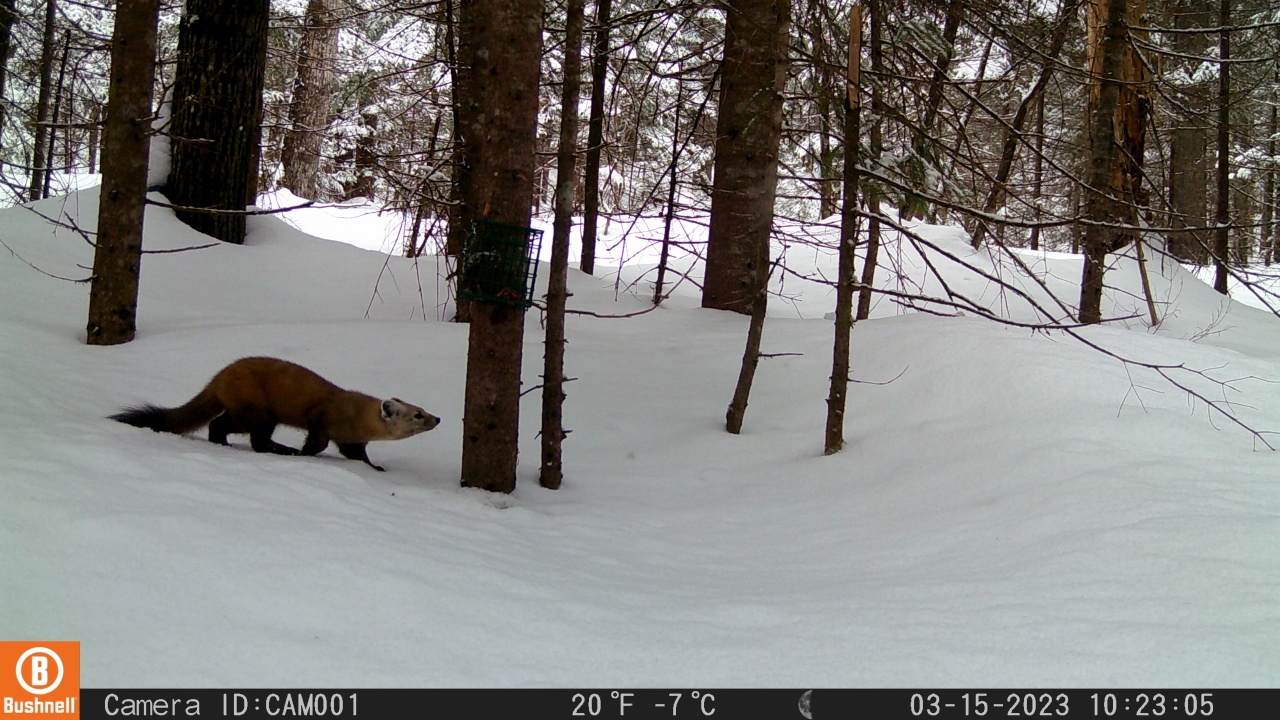
If you prefer to download individual images via http, you can. For example, the thumbnail below appears in the metadata as:
maine-difw-vol1/allag2_3_0575_20230315_102305_84.JPG
This image can be downloaded directly from any of the following URLs (one for each cloud):
Having trouble downloading? Check out our FAQ.
MegaDetector results for all camera trap datasets on LILA are available here.
Information about mapping camera trap datasets to a common taxonomy is available here.
- Source
- Slug: maine-difw-vol1
- Citation: Webb, S.M., Clarfeld, L.A., Huber, K.E., and Donovan. T.M., 2024, Maine Department of Inland Fisheries and Wildlife Volume 1 (2022 – 2023): U.S. Geological Survey data release, https://doi.org/10.5066/P9ML66K3.
This volume’s release consists of 64642 media files captured by autonomous wildlife monitoring devices under the project, Maine Department of Inland Fisheries and Wildlife. Maine Department of Inland Fisheries and Wildlife (MDIFW) preserves, protects, and enhances the inland fisheries and wildlife resources of the state. Established in 1880 to protect big game populations, MDIFW has since evolved in scope to include protection and management of fish, non-game wildlife, and habitats, as well as restoration of endangered species.
- Source
- Slug: simpl-wildlife-magnet-vol1
- Citation: Morelli, T. L., Sirén, A. P. K., Patry, R. K., Cliché, R. M., Clark, J. P., Loesberg, J. A., Courtot, K. A., Clarfeld, L. A., Huber, K. E., and Donovan, T. M., 2024, SiMPL Wildlife Magnet Project Data Release Volume 1 (2016 – 2023): U.S. Geological Survey data release, https://doi.org/10.5066/P1VUKJQK.
This volume’s release consists of 281258 media files captured by autonomous wildlife monitoring devices under the project, SiMPL Wildlife Magnet Project. The SiMPL Wildlife Magnet Project uses the SiMPL magnet camera trap design for monitoring climate, birds, and mammals (with a focus on small mammals) to evaluate the impacts of ecological forestry practices on wildlife species. Established in 2016, it includes sites in 3 regions in central New England and 1 region in northern Minnesota.
- Source
- Slug: silvio-conte-nfwr
- Citation: Cliche, R.M., Sirén, A.P.K., Clarfeld, L.A., Huber, K.E., and Donovan, T.M., 2024, Silvio O Conte National Fish and Wildlife Refuge Wildlife Monitoring Project (2014 – 2024): U.S. Geological Survey data release, https://doi.org/10.5066/P18M87XP.
This volume’s release consists of 90364 media files captured by autonomous wildlife monitoring devices under the project, Silvio O Conte National Fish and Wildlife Refuge Wildlife Monitoring Project. The Silvio O. Conte National Fish and Wildlife Refuge was established in 1997 to conserve, protect and enhance the abundance and diversity of native plant, fish and wildlife species and the ecosystems on which they depend throughout the 7.2 million acre Connecticut River watershed. The refuge manages lands within various divisions and units throughout the four watershed states of New Hampshire, Vermont, Massachusetts, and Connecticut.
- Source
- Slug: vermont-fw-vol1
- Citation: Gieder, K.D., Bernier, C.A., Royar, K., Siren, A.P.K., Crumley, K., Smith, T.R., Courtot, K., Wilson, T.L., Clarfeld, L.A., Huber, K.E., and Donovan, T.M., 2024, Vermont Fish and Wildlife Department Volume 1 (2014 – 2022): U.S. Geological Survey data release, https://doi.org/10.5066/P14MFBJT.
This volume’s release consists of 41933 media files captured by autonomous wildlife monitoring devices under the project, Vermont Fish and Wildlife Department. Vermont Fish and Wildlife Department’s mission is the conservation of fish, wildlife and plants and their habitats for the people of Vermont. The Department also endeavors to provide quality fish and wildlife-based recreation and reach Vermonters with the best possible information about these resources. The Department’s history extends back to 1866 and has evolved from game management to the wide variety of wildlife and habitat management and conservation it accomplishes today through staff employed in its Wildlife, Fish, Diversity, and Outreach Divisions.
- Source
- Slug: dartmouth-woodlands-vol1
- Citation: Patry, R.K., Sirén, A.P.K., Clarfeld, L.A., Huber, K.E., and Donovan, T.M., 2024, Dartmouth College Woodlands Wildlife Monitoring Project Volume 1 (2014 – 2024): U.S. Geological Survey data release, https://doi.org/10.5066/P133GQPK.
This volume’s release consists of 46576 media files captured by autonomous wildlife monitoring devices under the project, Dartmouth College Woodlands Wildlife Monitoring Project. The Grant has long been recognized as a model forest; one which balances wilderness recreation, timber harvesting that provides revenue for student scholarship, and a sustainably managed forest that supports education and research at Dartmouth and other institutions across the northern United States.
- Source
- Slug: usda-green-mountain-nf-vol1
- Citation: Gieder, K.D., Bernier, C.A., Staats, S.A., Wixsom, S.J., Abrams, R.J., Cahill, J.R., Crumley, K., Royar, K., Siren, A.P.K., Wilson, T.L., Clarfeld, L.A., Huber, K.E., and Donovan, T.M., 2024, USDA Green Mountain National Forest Volume 1 (2016 – 2022): U.S. Geological Survey data release, http://doi.org/10.5066/P1GVIBFL.
This volume’s release consists of 84049 media files captured by autonomous wildlife monitoring devices under the project, USDA Green Mountain National Forest. US Forest Service’s mission is to sustain the health, diversity, and productivity of the Nation’s forests and grasslands to meet the needs of present and future generations. Grounded in world-class science and technology– and rooted in communities–the U.S. Department of Agriculture (USDA), Forest Service connects people to nature and to each other. As a Federal agency in service to the American people, the Forest Service cares for shared natural resources in ways that promote lasting economic, ecological, and social vitality.
- Source
- Slug: usda-white-mountain-nf-vol1
- Citation: Prout, L.S., Siren, A.P.K., Callahan, C.B., Wilson, T.L., Clarfeld, L.A., Huber, K.E., and Donovan, T.M., 2024, USDA White Mountain National Forest Volume 1 (2014 – 2024): U.S. Geological Survey data release, http://doi.org/10.5066/P1PUEYQK.
This volume’s release consists of 325099 media files captured by autonomous wildlife monitoring devices under the project, USDA White Mountain National Forest. US Forest Service’s mission is to sustain the health, diversity, and productivity of the Nation’s forests and grasslands to meet the needs of present and future generations. Grounded in world-class science and technology– and rooted in communities–the U.S. Department of Agriculture (USDA), Forest Service connects people to nature and to each other. As a Federal agency in service to the American people, the Forest Service cares for shared natural resources in ways that promote lasting economic, ecological, and social vitality.
- Source
- Slug: maine-difw-moose-vol2
- Citation: Kantar, L.E., Sirén, A.P.K., Wilson, T.L., Clarfeld, L.A., Huber, K.E., and Donovan, T.M., 2024, Maine Department of Inland Fisheries and Wildlife Moose Project – Volume 2 (2021 – 2024): U.S. Geological Survey data release, https://doi.org/10.5066/P132SU4S.
This volume’s release consists of 320104 media files captured by autonomous wildlife monitoring devices under the project, Maine Department of Inland Fisheries and Wildlife. Maine Department of Inland Fisheries and Wildlife (MDIFW) preserves, protects, and enhances the inland fisheries and wildlife resources of the state. Established in 1880 to protect big game populations, MDIFW has since evolved in scope to include protection and management of fish, non-game wildlife, and habitats, as well as restoration of endangered species.
- Source
- Slug: nh-fish-game-vol1
- Citation: Jones, H., Sirén, A.P.K., Callahan, C.B., Holman, H., Marchand, M.N., Kilborn, J.R., Wilson, T.L., Morelli, T.L., Clarfeld, L.A., Huber, K.E., and Donovan, T.M., 2024, New Hampshire Fish and Game Department Volume 1 (2014 – 2024): U.S. Geological Survey data release, https://doi.org/10.5066/P13ISNAI.
This volume’s release consists of 463615 media files captured by autonomous wildlife monitoring devices under the project, New Hampshire Fish and Game Department. As the guardian of the state’s fish, wildlife and marine resources, the New Hampshire Fish and Game Department works in partnership with the public to: conserve, manage, and protect these resources and their habitats; inform and educate the public about these resources; and provide the public with opportunities to use and appreciate these resources.
- Source
- Slug: massachusetts-wildlife
- Citation: Wilson, T.L., Siren, A.P.K., Berube, J.A., Morrow, C.M., Wattles, D.W., Huguenin, M., Clarfeld, L.A., Huber, K.E., Donovan, T.M., 2024, Massachusetts Wildlife Monitoring Project (2022 – 2024): U.S. Geological Survey data release, https://doi.org/10.5066/P13UNTFB.
This volume’s release consists of 143321 media files captured by autonomous wildlife monitoring devices under the project, Massachusetts Wildlife Monitoring Project. In 2022 the Massachusetts Cooperative Research Units established an array of 60 trail cameras at in MA to evaluate the potential drivers of winter tick epizootics in moose. The array was established under the protocol used by the Northeast Wildlife Monitoring Network (NEWMN), thereby ensuring that it has several features enabling multi-species monitoring: randomized multi-scale nested design; encompasses large latitudinal and elevational gradients; samples sites with the highest and lowest average forest cover within selected blocks; year-round deployment; and use of trails and lure to maximize detection. As a result of this the camera array is suitable for monitoring a diverse array of species, including many furbearers in need of baseline data. In addition to the ubiquitous deer, moose, and bears we already have repeated detections of coyote, bobcat, fisher, red fox, and raccoon.
Posted by Dan Morris.